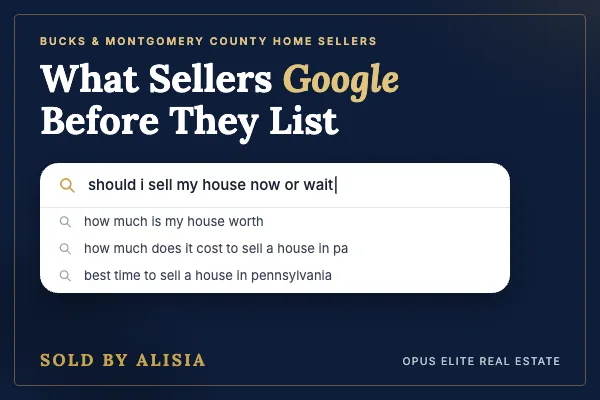
What Bucks County Sellers Google Before They List Their Home
Before most homeowners ever call an agent, they open Google. So I looked at the actual search suggestions Google shows when people start typing questions about selling a house in Pennsylvania. The same questions come up again and again, from "how much is my house worth" to "should I sell my house now or wait until 2027."
Here are clear answers to each one, using the most recent numbers for Bucks County and Montgomery County.
1. How much is my house worth?
This is the number one question, and Google's suggestions show where people go next: "how much is my house worth Zillow," "Redfin," and "calculator."
Online estimates are a fine starting point, but they can't see your updated kitchen, your finished basement, your lot, or the difference between two streets in the same neighborhood. They work off averages, and your home isn't average.
For context, the median sale price in Bucks County was $525,000 in August 2026, about 1% lower than a year earlier, according to Redfin. In Montgomery County the median was $508,299, up about 8% from last year. Those county numbers hide big swings from town to town. A home in Newtown, Yardley, or Doylestown can sell for a very different price than a home of similar size in Langhorne or Levittown.
The most accurate answer comes from a comparative market analysis (CMA) built on recent sales right around you and adjusted for your home's condition and updates.
2. Should I sell my house now or wait until 2027?
Google finishes this sentence for people, which tells you how many sellers are on the fence right now.
Here's what the local data says. In Bucks County, the typical home went under agreement in 27 days in August, sold for 100.4% of list price, and 43.8% of homes sold over asking (Redfin). Montgomery County looked similar: 29 days, 100.7% of list price, and 47.1% sold over asking. Buyers are still out there, and they are still competing for homes that are priced well.
At the same time, about 18% of Bucks County listings had a price drop, and mortgage rates have been climbing. Freddie Mac's average 30 year fixed rate hit 7.40% on October 8, 2026, up from 6.30% a year ago and the highest weekly average since November 2023. Higher rates shrink what buyers can afford each month.
Nobody can promise where prices or rates will be in 2027, so waiting is a bet. A better question is whether your next move makes sense now. If you need more space, less space, or a different location, the right price today usually beats guessing about next year.
3. When is the best time of year to sell a house in Pennsylvania?
"Selling a house in winter vs spring" is one of the most common timing questions people type into Google, and the answer has more nuance than "wait for spring."
Spring brings the most buyers, and it also brings the most competing listings. Fall and winter sellers face fewer competing homes, and the buyers shopping from October through January tend to be serious: relocations, job changes, growing families, and people who missed out in the spring. With local homes still going under agreement in under a month, a well prepared fall listing doesn't have to wait for the tulips.
The best time to sell is when your home is ready, your next step is lined up, and your price fits the current market.
4. How much does it cost to sell a house in PA?
Most sellers focus on the sale price and forget about what comes out of it. In Pennsylvania, the main costs to plan for are:
Realty transfer tax. In Bucks County the total is 2% of the sale price (1% state and 1% local), and buyers and sellers customarily split it, so sellers typically pay about 1%. On a $525,000 sale, that's roughly $5,250. Rates can be higher in some municipalities, so confirm the rate for your town.
Real estate commission. Negotiated between you and your agent (more on this below).
Mortgage payoff, including any home equity line of credit.
Prorated property taxes, split with the buyer based on the settlement date.
Repairs or credits negotiated after the buyer's home inspection.
Seller concessions you agree to, such as help with the buyer's closing costs.
Township fees and required repairs for a resale use and occupancy (U&O) certificate, if your municipality requires one.
Then there's the question Google gets asked all the time: "Do you get a check when you sell your house?" Yes. Once everything above is paid at settlement, your net proceeds are paid to you by check or wire through the title company. One important tip: always confirm wire instructions by calling the title company at a phone number you already know. Wire fraud aimed at home sellers is real.
Before you list, ask for a seller net sheet. It shows what you'll actually walk away with at different sale prices.
5. How does realtor commission work now?
Searches like "realtor commission paid by seller" and "average realtor commission PA" show up constantly, and it's no surprise after the national rule changes that took effect in August 2024. Here's what you need to know:
Commissions are negotiable and always have been. No law sets a standard rate.
Offers of compensation to buyer agents no longer appear in the MLS, and buyers now sign a written agreement with their own agent before touring homes.
As a seller, you can still choose to offer compensation to a buyer's agent or offer concessions to the buyer. Whether that makes sense for your home is a strategy decision, and it can affect how many buyers are able to make an offer.
A good listing agent should walk you through these options in plain numbers before you sign anything.
6. What should I fix before selling my house, and what should I skip?
Google shows both versions of this question, "what to fix before selling" and "what not to fix," and both matter.
Usually worth doing:
Anything a buyer's home inspector will flag as a safety or water issue, like leaks, electrical problems, missing smoke or carbon monoxide detectors, and loose railings
Servicing the heating and air conditioning system and keeping the receipt
Fresh, neutral paint in rooms that need it
Small fixes that photograph well: lighting, cabinet hardware, caulk, landscaping, and mulch
Usually not worth doing:
A full kitchen or bathroom remodel right before listing
Major projects you won't be around to enjoy, when a price adjustment or credit would cost you less
Every house is different, so walk through it with an agent before you spend money. Sometimes the best plan is a deep clean, a fresh coat of paint, and smart pricing.
7. How long does it take to sell a house in PA?
Right now the typical Bucks County home goes under agreement in about 27 days, and Montgomery County is close behind at 29 days (Redfin, August 2026). After that, settlement usually takes another 30 to 60 days, depending on the buyer's financing and the timeline you negotiate.
A realistic plan is two to three months from the day you list to the day you hand over the keys, plus a few weeks beforehand to prepare, photograph, and price the home. Homes that start out priced too high take longer and often end up needing a price cut anyway.
8. Will I pay taxes when I sell my house?
Google's suggestions here include "selling my house do I pay capital gains" and "what taxes do you pay when you sell a house in PA." For most people selling their primary home, the news is good.
Federal: If you owned and lived in the home as your main residence for at least two of the last five years, you can generally exclude up to $250,000 of profit if you're single, or up to $500,000 if you're married and file jointly.
Pennsylvania: PA has its own two out of five year test. If you meet it, the gain on your primary residence is generally exempt from PA personal income tax. If you don't, the gain is taxed at the state's flat 3.07% rate.
Rentals, second homes, inherited properties, and homes with a home office are different situations. Talk with your CPA or tax advisor before you list so there are no surprises.
9. What do I have to disclose when selling a house in PA?
Pennsylvania's Real Estate Seller Disclosure Law requires most sellers of homes with one to four units to give buyers a completed Seller's Property Disclosure Statement before the buyer signs the agreement of sale.
You must disclose material defects you know about, such as roof leaks, water in the basement, foundation or structural issues, problems with major systems, and past repairs. You aren't required to hire an inspector to search for hidden problems, but you can't leave out what you know. Some sales, like certain estate sales and foreclosures, are exempt from the form, though not from being honest.
A thorough, accurate disclosure protects you. When in doubt, disclose.
10. Should I buy or sell first?
This is one of the most stressful questions for people moving up or downsizing, and there's no single right answer. Common paths include:
Sell first, then negotiate a later settlement date or a short rent back so you aren't forced to move twice
Buy first using a bridge loan or home equity line, if your finances support carrying two homes for a short time
Buy with a home sale contingency, which can work in some cases but is weaker when buyers are competing for the same home
The right choice depends on your equity, your lender, and how competitive your next town is. It's worth mapping out before your home ever hits the market.
The local question Google doesn't answer well: Do I need a U&O?
National search results won't warn you about this one, but it can catch Bucks and Montgomery County sellers off guard.
Many Pennsylvania municipalities require a resale use and occupancy (U&O) inspection before you can settle. The township checks basic safety items, and anything that fails has to be fixed before settlement, or handled under a temporary certificate if the township allows it.
Rules vary a lot by township. Warrington Township, for example, requires a U&O for every residential resale, charges a $140 fee, and the certificate is only valid for 60 days. Other townships require one only for new construction. Find out your township's rules when you list, and apply as soon as you're under contract so a surprise repair doesn't delay your settlement.
Get answers for your address, not just your county
Google can get you started, but it can't walk through your home, pull the sales on your street, or tell you what you'll net in today's market.
If you're thinking about selling in Bucks County, Montgomery County, or nearby New Jersey, I'll put together a free home value report and a seller net sheet for your property. No pressure and no obligation, just real numbers.
Call or text me at 267.269.3973, email [email protected], or visit soldbyalisia.com.
Alisia
Sold by Alisia | Opus Elite Real Estate
Market figures are from Redfin (August 2026) and Freddie Mac (October 8, 2026). This post is general information, not legal or tax advice.


